

Preferreds & Amplification
Start with the cash yield a preferred share pays at a given purchase price, then compare fixed claims with resetting amplification at a Bitcoin peak. Your assumptions throughout; modeled mechanics, not stock-price forecasts.
Preferred Cash Yield Calculator
Same annual dividend. Different purchase price. See how your cash yield changes.
Price–Yield Curve
$100.00 purchase → 15.00% annual cash yield
Annual cash yield = annual dividend per share ÷ purchase price × 100
What if the price changes after I buy?
Your purchase price stays fixed. A different market price changes your position’s value, not the assumed dollar dividend.
Illustrative one-year total return
$20 is this calculator’s minimum input, not a market price floor.
Amplification Calculator
Same Bitcoin held. Same senior claims. Only Bitcoin’s price changes.
Amplification vs. Bitcoin Price Change
0.00% Bitcoin → 50.00% amplification
Claims = starting price × starting amplification. Current value = starting price × (1 + change). Current amplification = fixed senior claims ÷ current value of 1 BTC × 100. The starting price scales the dollars, not the ratio. Percentages are of Bitcoin assets, not a return to common shareholders.
Fixed senior claims exclude dividends, expenses, other assets, cash and debt terms. Illustrative mechanics only.
Advanced: peak, reset & drawdown
Compare fixed claims with resetting amplification at a Bitcoin peak, then stress both paths with a drawdown. Fixed BTC holdings; modeled mechanics, not stock-price forecasts.
Path 1 · Let amplification fall
50% → 25% → 41.67%
Amplification (claims/BTC value)
41.67%
Path 2 · Reset at peak
50% → 25% → 50% → 83.33%
Amplification (claims/BTC value)
83.33%
Reset adds $75,000,000 of fixed claims at the peak (C1 − C0). Bitcoin held stays at 1,000 BTC: this is a mechanical fixed-holdings stress test, not a funding-transaction model — the proceeds of the added claims are not modeled.
Path 1 · Let amplification fall
- Start
- BTC price
- $150,000
- BTC value
- $150,000,000
- Fixed claims
- $75,000,000
- Residual BTC backing after claims
- $75,000,000
- Amplification (claims/BTC value)
- 50%
- Peak · before decision
- BTC price
- $300,000
- BTC value
- $300,000,000
- Fixed claims
- $75,000,000
- Residual BTC backing after claims
- $225,000,000
- Amplification (claims/BTC value)
- 25%
- Peak · after decision
- BTC price
- $300,000
- BTC value
- $300,000,000
- Fixed claims
- $75,000,000
- Residual BTC backing after claims
- $225,000,000
- Amplification (claims/BTC value)
- 25%
- After drawdown
- BTC price
- $180,000
- BTC value
- $180,000,000
- Fixed claims
- $75,000,000
- Residual BTC backing after claims
- $105,000,000
- Amplification (claims/BTC value)
- 41.67%
Path 2 · Reset at peak
- Start
- BTC price
- $150,000
- BTC value
- $150,000,000
- Fixed claims
- $75,000,000
- Residual BTC backing after claims
- $75,000,000
- Amplification (claims/BTC value)
- 50%
- Peak · before decision
- BTC price
- $300,000
- BTC value
- $300,000,000
- Fixed claims
- $75,000,000
- Residual BTC backing after claims
- $225,000,000
- Amplification (claims/BTC value)
- 25%
- Peak · after decision
- BTC price
- $300,000
- BTC value
- $300,000,000
- Fixed claims
- $150,000,000
- Residual BTC backing after claims
- $150,000,000
- Amplification (claims/BTC value)
- 50%
- After drawdown
- BTC price
- $180,000
- BTC value
- $180,000,000
- Fixed claims
- $150,000,000
- Residual BTC backing after claims
- $30,000,000
- Amplification (claims/BTC value)
- 83.33%
Residual BTC backing after claims = modeled Bitcoin value − modeled fixed claims. It excludes other assets, cash and operating value; fees, dividends, debt maturities and other obligation details are not modeled. This is not a traded common-equity valuation or an assessment of ability to meet obligations.
Crash discipline
Maximum peak amplification that stays at or below a target after a 40% drawdown. Drawdown multiplier 1/(1 − D) = 1.6667×.
Target 50%
30%
Target 60%
36%
Target 70%
42%
Target 80%
48%
Formulas & assumptions
- Amplification = fixed claims ÷ (BTC held × BTC price)
- C0 = A0 × H × P0; peak amplification = A0 × P0 ÷ P1
- P2 = P1 × (1 − D)
- Path 1: claims stay C0; final = C0 ÷ (H × P2)
- Path 2: claims reset to C1 = A0 × H × P1 at the peak; final = A0 ÷ (1 − D)
Bitcoin holdings are fixed throughout. No costs, dividends, fees, taxes or new BTC purchases are modeled. The reset is a one-time step at the peak, not continuous financing. At 100%, modeled residual backing is zero; above it, negative—not an automatic bankruptcy trigger or a prediction of traded common-share value. The 35%/70% chart zones are educational markers from the original graphics, not validated universal thresholds. Scenarios illustrate mechanics and do not predict stock prices.
Read the full Technical Note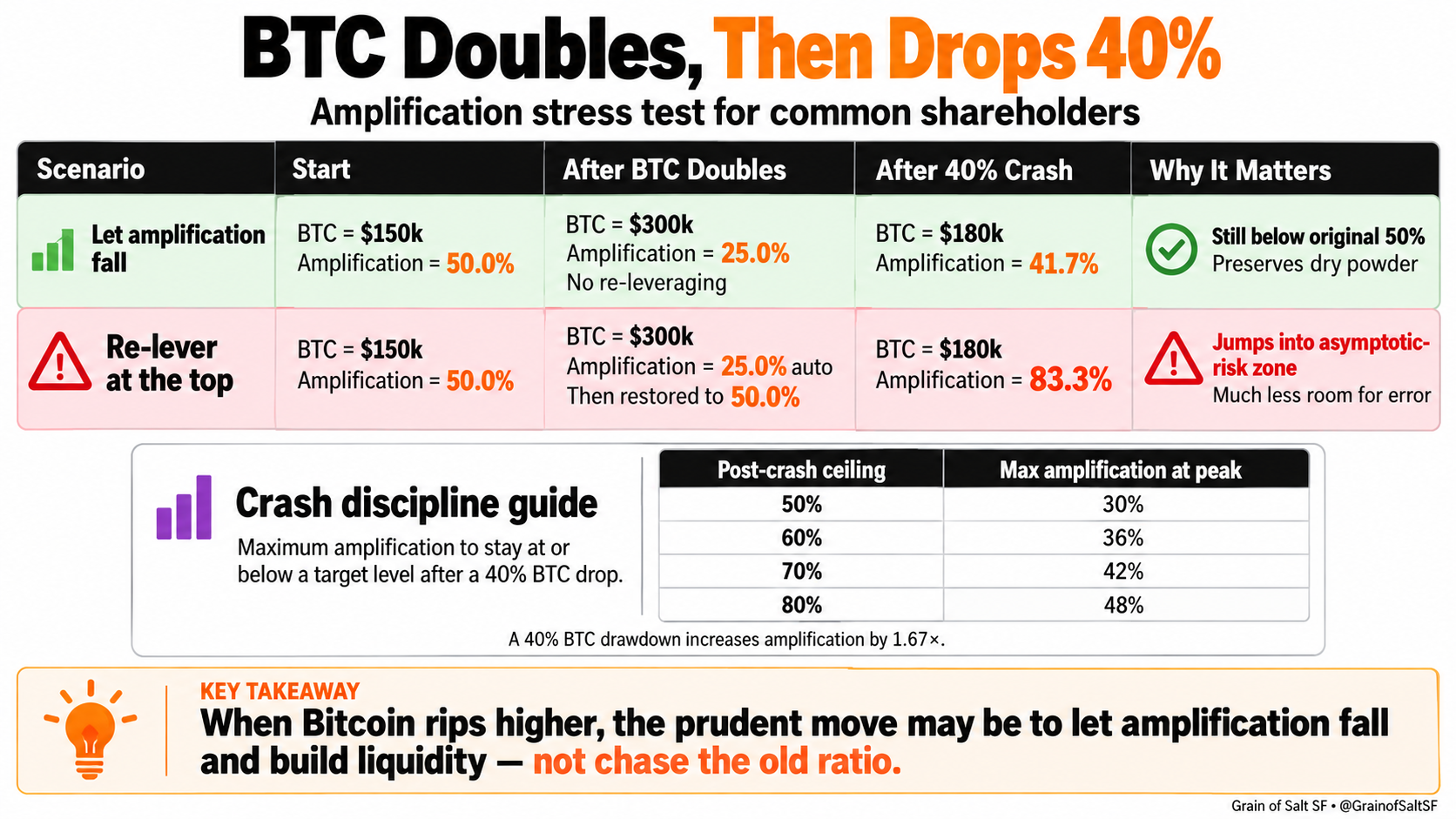
Bitcoin doubles, then drops 40%: letting amplification fall versus resetting at the top
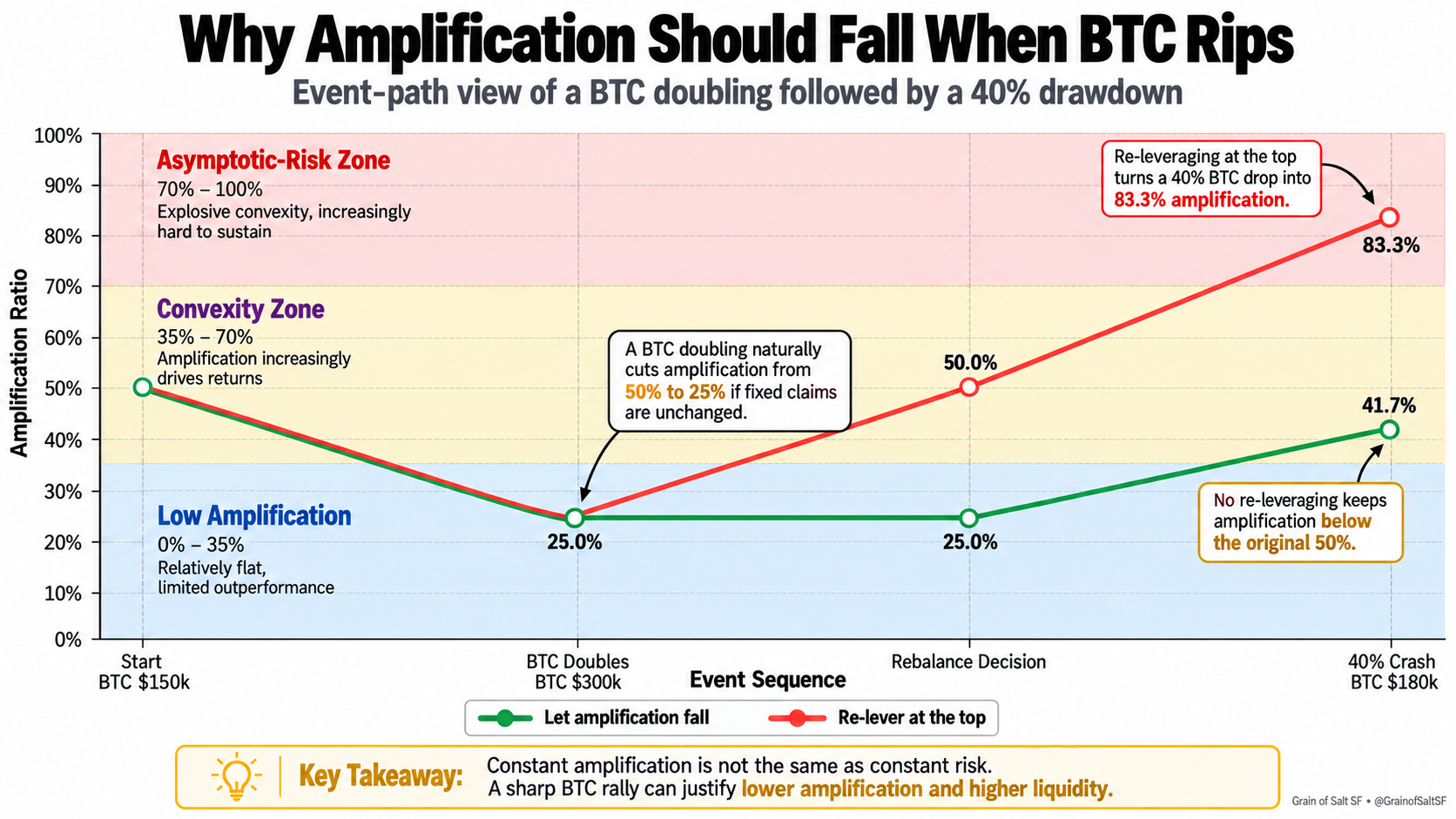
Why amplification should fall when Bitcoin rips: event path from 50% to 25%, then 41.7% versus 83.3%